

Inside the Energy Transition
Edition #5 - What the Best Teams Are Doing Differently in 2026
February 2026
Across the energy transition, the focus has shifted from momentum to delivery. Ambition is still there, but it is being tested against execution, resilience and leadership capability in a much more tangible way.
What we are seeing, consistently, is that the strongest teams are not defined by noise or narrative. They are defined by clarity. Clear priorities. Clear ownership. Clear decision-making. These organisations are spending less time reacting and more time building the structures and behaviours that allow them to perform under pressure.
This pattern holds across markets and geographies. Whether in the US, Asia, or Europe, and regardless of technology or sector, high-performing teams are making deliberate choices about how they operate and how leaders show up when things get harder.
This edition focuses on those observable behaviours. Not forecasts or commentary, but the practical differences we see between teams that are delivering in 2026 and those that are still finding their footing.

Our 2026 Compensation Guides are now live!
Whether you're building a new function, reviewing internal structures, or planning ahead for 2026, our reports combine verified placement data, real-time intelligence from ongoing mandates, and insights drawn from hundreds of conversations with candidates and hiring teams every day.
Download the 2026 compensation guides
The Operating Environment in 2026
If 2026 feels more demanding than previous years, the data explains why. Capital is still there, but patience is thinner. Timelines are longer. Costs are stickier. The margin for execution error has narrowed materially, and leadership teams are being exposed accordingly.
United States
- Annual clean energy investment remains above $300bn, but growth has plateaued, with capital increasingly concentrated in assets that are already operational or close to delivery.
- Grid interconnection queues in several regions now stretch beyond 5–7 years, turning delivery capability into a competitive advantage rather than a hygiene factor.
- Many operators are holding headcount flat, redirecting spend toward experienced delivery and operational leadership instead of continued expansion.
Europe
- Energy transition investment has stabilised rather than rebounded, signalling a shift from acceleration to discipline.
- Project costs across renewables and infrastructure remain 20–30% above pre-2020 levels, leaving little room for weak controls or indecision.
- Hiring volumes are down, but demand for senior operators, engineers and delivery-focused leaders remains consistently strong across core markets.
2026 is not a slowdown. It is a filter. Teams that relied on favourable conditions are being found out, while those built around execution, accountability and experienced leadership are compounding quietly. The gap between the two is widening.
Sources: International Energy Agency, BloombergNEF, US Department of Energy, European Commission
How High-performing Teams are Responding: US vs Europe
The US and Europe continue to operate under different structural conditions in 2026. Capital, timelines and regulatory environments still diverge. What is increasingly similar is how the strongest teams are choosing to respond.
In the US, scale remains the advantage and the risk. High-performing teams are investing earlier in organisational structure, bringing in experienced operators before complexity peaks, and drawing clearer lines between strategy and delivery. Where performance slips, it is rarely due to market conditions. It is because growth has outpaced internal decision-making and accountability.
In Europe, tighter constraints have forced sharper discipline. With less room for error, the strongest teams are more deliberate in how they sequence work, assign ownership and manage cost. Leadership groups tend to be smaller, more experienced, and closer to execution. Progress may be slower, but it is often more controlled.
The convergence is telling. On both sides of the Atlantic, high-performing teams are pushing decision-making closer to delivery, reducing consensus-heavy processes and backing accountable leaders to act. Operational capability is no longer something to build later. It is being treated as foundational.
In 2026, the differentiator is not ambition or geography. It is whether teams have built organisations that can deliver reliably under pressure.
Conversations in Cleantech
Season 10: Digital Infrastructure Deconstructed
Season 10 of Conversations in Cleantech focuses on digital infrastructure, one of the most complex and consequential parts of the energy transition.
As AI, data and compute demand accelerate, the pressure has shifted from expansion to execution. Power availability, grid access, talent, capital structure and supply chains are now the defining constraints. This season brings those realities into focus through conversations with the leaders building, financing and operating digital infrastructure at scale.
Across eight episodes, we explore the decisions shaping delivery in 2026, from skills and capital allocation to manufacturing capacity, emerging geographies and energy optimisation software.
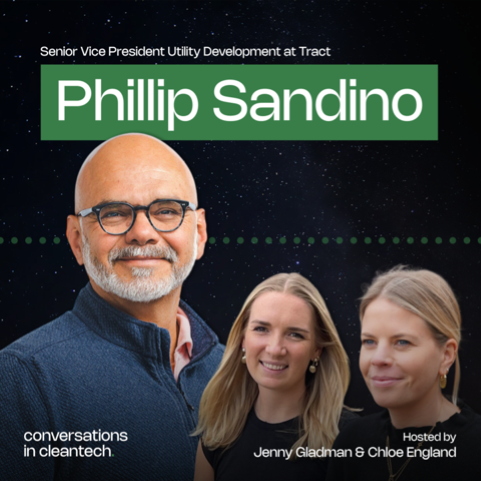
Phillip Sandino, Senior Vice President Utility Development at Tract
In this episode, Phillip unpacks how grid planning must evolve to meet hyperscale demand, why credibility is critical for project viability, and what power procurement really looks like behind the scenes. Along with hosts Jenny Gladman and Chloe England, they explore what it means to build with foresight, how Tract works to de-risk and accelerate utility timelines, and why gigawatt-scale development requires new models of partnership.
Catch Up on Last Season
Ishan Jaithwa Head of Data Center Strategy at Cypress Creek.

Deep Dive: Why Talent Is Becoming the Defining Variable for Digital Infrastructure
Our latest article explores why digital infrastructure has moved beyond being a technology conversation and become an energy, industrial and competitiveness issue in 2026.
As AI-driven demand accelerates, power availability, grid access, regulatory scrutiny and supply-chain pressure are converging across both Europe and the US. The piece examines how these forces are reshaping not just where infrastructure gets built, but how organisations think about capability, leadership and team design. With global data-centre capacity expected to nearly double by 2030, the question is no longer whether demand exists, but whether the ecosystem can deliver at pace under tightening constraints.
The article compares the realities facing Europe and the US, from grid bottlenecks and regulatory frameworks to scale-driven pressure on energy systems, and outlines what this means for the workforce. As digital infrastructure increasingly behaves like critical infrastructure, talent, operational maturity and embedded capability are becoming as decisive as capital.
Current Opportunities in Europe & the US
Head of Project Finance Austin, Texas, USA
Senior Grid Expert Rome, Italy
Project Engineer United States (Remote)
Head of Planning London, UK
Project Finance Manager Washington D.C., USA
Head of Corporate Finance United Kingdom (Remote)
Director of Grid Analytics United States (Remote)
Head of Product London, UK
Technical Operations Lead United States (Remote)
Project Developer Hamburg, Germany
On the Road – Global Events You'll Find us at!
Our team will be out in the field, connecting with clients, candidates, and partners across the clean energy ecosystem. Events are where ideas turn into action and where we get the chance to hear directly from the people driving the transition forward.
Come and find us at:
DTECH
Offshore Technology Conference

Let’s Talk Talent
2026 is already testing how quickly organisations can move from intent to action. Delivery timelines are tightening, investment scrutiny is higher, and the margin for hiring missteps is smaller than ever.
Brightsmith works alongside industry, professional services and investment teams to bring in leaders who can step in, take ownership and move projects forward, across engineering, operations, commercial strategy, policy and delivery.
If you’re making decisions this year that will shape the next phase of your business, we help ensure the people behind them are the right ones.

