


Inside the Energy Transition
Edition #2 - Capital Confidence: Where Investment Is Defining the Energy Transition
November 2025
Welcome to the second edition of Inside the Energy Transition.
Where our first issue was about regulation, this month is about capital: where it is flowing, what is stalling, and what that says about the next phase of the clean economy.
Investment trends tell a story beyond sentiment. They reveal how confidence, policy, and execution are aligning, or in some cases diverging. Across the Atlantic, we are seeing two different models emerge: the US pulling ahead in manufacturing and hydrogen through policy certainty, and Europe refining its position in grid integration, renewables, and system resilience.
At Brightsmith, we see this reflected in leadership demand. Roles that connect capital to delivery, such as CFOs, policy strategists, and project finance leaders, are now defining competitiveness. The organisations moving fastest are not just chasing incentives; they are hiring the people who can make them work.
That is the real signal behind the numbers: confidence follows clarity, and clarity starts with leadership.
If there’s a topic you’d like us to cover next month, let us know. And if you’d like this delivered straight to your inbox, you can subscribe on the right.


The Numbers Behind the Transition
Capital investment across clean energy reached record levels in 2025, but where it is landing tells a more complex story about confidence and competitiveness.
United States
- Over $70 billion in clean manufacturing investment in the past 12 months
- 30+ gigafactories under construction or announced
- $8 billion in conditional DOE funding for hydrogen hubs
- Private investment in transmission and grid upgrades up 40% year-on-year
Europe
- More than €55 billion in committed clean industry funding since 2023
- France, Germany, and Spain capture 70% of large-scale new projects
- Investment in hydrogen electrolysers down 15%, while battery and e-mobility projects accelerate
- 60% of investors cite “policy fragmentation” as their main barrier to scaling capital deployment
Investment priorities vary sharply by region. In the United States, capital continues to concentrate in manufacturing, hydrogen, and grid infrastructure, reflecting strong policy visibility and long-term incentive certainty. In Europe, investors are favouring offshore wind, battery recycling, and energy flexibility projects that strengthen system resilience. Globally, funding is flowing into green steel, sustainable fuels, and supply chain localisation as emerging markets seek to capture industrial value. Overall, policy clarity remains the decisive factor: the US is benefiting from consistent federal incentives, while Europe’s competitiveness will depend on how quickly reforms translate into predictable returns.
Sources: BloombergNEF; IEA; DOE; European Commission; Bruegel; IRENA; McKinsey Global Energy Perspective.
Capital Flows & Competitiveness: Europe VS. The US
The energy transition has entered a new phase, one defined less by technology readiness and more by capital allocation.
In the United States, the Inflation Reduction Act continues to reshape industrial geography. Battery, hydrogen, and carbon capture facilities are moving from plan to construction at unprecedented speed. Federal and private capital are aligning, and policy visibility is allowing companies to plan five to ten years out. The risk lies in execution, particularly the availability of project delivery and finance talent to meet timelines.
In Europe, capital is increasingly selective. The Net-Zero Industry Act and national support schemes have created strong signals, but implementation lags. Higher energy costs, fragmented state aid, and slow permitting mean investors are favouring markets with clear national roadmaps.
What this means for business:
- Capital follows certainty. Companies that align with transparent policy frameworks and clear permitting pathways are attracting disproportionate investment.
- Execution risk is the new bottleneck. As funding commitments accelerate, competition is intensifying for senior finance, construction, and grid integration leaders.
- Cross-border experience is now a premium skillset. Firms expanding transatlantically are prioritising executives who can navigate both US incentive structures and EU compliance frameworks.
For leadership teams, the message is clear: access to capital will increasingly depend on access to talent, especially those who understand how to turn regulation into results.
Sources: US Treasury; DOE; EIB; PwC Energy Transition Investments 2025; European Council.
Conversations in Cleantech - Season 9: Investing in Transition Infrastructure
Catch up on our latest episodes:

Laurie Menoud, Founding Partner & Helen Lin, Partner At One Ventures
With backgrounds spanning biotech, physics, finance and microfinance, Laurie and Helen are part of a founding team built on diverse experience and shared conviction. Together, they’re investing in breakthrough technologies that aren’t just greener - they’re fundamentally better, more scalable and economically inevitable.
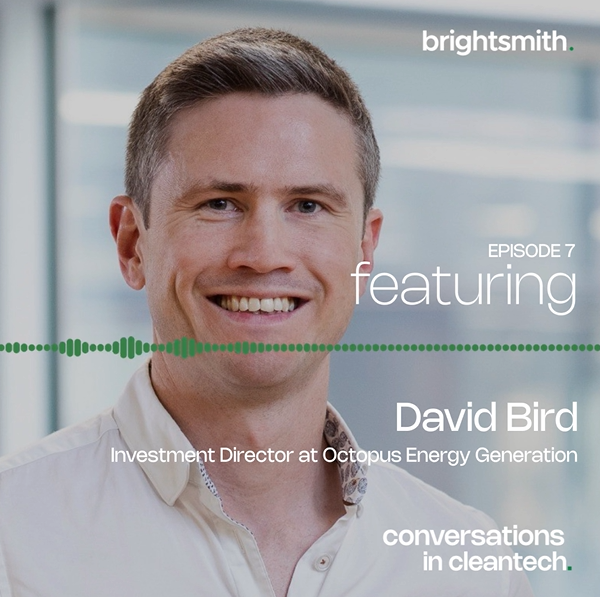
David Bird, Managing Director and Head of the Climate Finance Partnership at ORIT
With over 15 years in clean energy and a decade of experience at Octopus Energy Generation, David brings deep insight into what it takes to fund, develop and scale real-world renewable infrastructure. From repositioning ORIT’s strategy in the face of rising interest rates, to backing development-stage projects across Europe, David outlines how Octopus is reframing renewables as a growth opportunity - not just a bond alternative.
Upcoming Episodes
Releases 11 Nov 2025
Ishan Jaithwa Head of Data Center Strategy at Cypress Creek.
Releases 25 Nov 2025

Deep Dive: Where Capital is Being Deployed
Written by Richard Ashworth-Lord, Senior Manager, this piece explores U.S. manufacturing construction is running at historically high levels, with spending at roughly $223 billion as of July 2025, more than double pre-2021 norms. It signals the scale of factories now breaking ground across semiconductors, batteries, EVs, and clean tech...
Read the full piece on LinkedIn →
Written by Isabella Rova, Director of Financial Services, this piece looks at how cleantech investment in Europe is shifting from isolated technologies to an integrated, system-wide approach. It highlights how capital is flowing across the full value chain, from grids and storage to hydrogen and carbon capture, and how government backing, policy alignment, and patient capital are now essential to unlocking private investment.
In-Demand Roles This Month
Lead Grid Integration Manager EMEA (remote)
Financial Planning & Analysis Manager Germany
Project Manager - Onshore Wind Munich, Germany
Director of Origination United States (remote)
Origination Manager Paris, France
Lead Process Engineer Washington DC
Director of Engineering London, UK
Vice President - Infrastructure & Real Assets London, UK
Senior Legal Counsel London, UK
General Counsel United States
Navigating Your Career at the Executive Level - Panel & Networking Event for Women across the Energy Transition
Join Brightsmith and Third House for a panel discussion and networking evening exploring what it really means to grow, evolve and lead at the highest levels of the energy transition, spotlighting women’s experiences at the executive level.
The conversation will examine the realities of executive career progression, from navigating change and redefining success, to championing the next generation of leaders through the lens of the women driving the transition.
Expect open, honest discussion and practical insight from those who’ve been there, followed by informal networking over drinks in a festive setting.
Navigating Your Career at the Executive Level

Let’s Talk Talent
Capital builds factories. People build futures.
Brightsmith partners with investors, developers, and technology companies to help them find the leaders who turn policy and investment into measurable progress. Whether you are deploying capital or preparing to raise it, success depends on aligning your leadership strategy with your growth ambitions.
We help you build those teams: purpose-driven, execution-ready, and globally connected.

