


Inside the Energy Transition
Edition #3 - From Pipeline to Performance: How Leaders Prepare for 2026
December 2025
Why 2026 Starts Now
Talent planning is often framed as something you do once the strategy is fully formed. In reality, especially across the energy transition, it is the opposite. Ambition only becomes execution when the right people are in place early enough to make it happen.
Across both the US and Europe, 2026 is emerging as a decisive year. In the US, federal incentives have unlocked a wave of manufacturing, power generation, data center and grid projects that will move from design into large-scale delivery over the next 18–24 months. In Europe, the momentum sits in system integration, offshore wind, storage, and regulatory-driven resilience work, but the talent pressures are no less acute.
What links the two markets is timing. Senior hiring cycles in clean energy can run two to five months, and leadership onboarding adds further runway. That means your 2026 capability depends on the decisions you're making now and in Q1 2026.
At Brightsmith, we’re seeing organisations on both sides of the Atlantic shift from reactive hiring to intentional workforce design, building leadership benches, commissioning compensation studies ahead of market entry, and aligning talent timelines with project milestones. It’s a smarter, more confident way to grow.
If you're entering your workforce planning cycle and would value a strategic discussion, feel free to reach out.


The Numbers Behind the Transition
The workforce needs of 2026 are already taking shape across both the US and Europe. Project pipelines, regulatory timelines, and major build-outs are creating clear signals about where talent will be constrained and where organisations need to plan ahead.
United States
- Clean energy employment continues to outpace the wider economy, growing 4.2% in 2023 vs 2% nationally.
- Major IRA-backed projects in storage, hydrogen, and manufacturing are driving sustained demand for systems, process, and mechanical engineers.
- Transmission and grid modernisation projects are expanding, with workforce needs rising across permitting, interconnection, and T&D engineering.
- Regional hiring pressure remains highest in California, Texas, and the Northeast, where project density pulls talent from other states.
- Site-based roles, commissioning, and operations leadership roles are experiencing increased mobility and relocation challenges as gigafactories and hydrogen hubs ramp.
Europe
- EU clean energy jobs surpassed 1.8 million, with growth strongest in offshore wind, flexibility, storage, and grid upgrades.
- Talent bottlenecks are most acute in permitting, project delivery, and TSO/DSO-linked engineering, as Europe accelerates grid resilience programmes.
- Large-scale battery, electrolyser, and manufacturing projects in Spain, Portugal, Italy, and Germany are driving demand for industrialisation and operations leadership.
- Northern and Western Europe continue to attract the majority of senior technical talent, widening capability gaps in Southern and Eastern European markets.
- Regulatory-driven skill needs (e.g. EU Battery Regulation, cross-border market integration) are increasing demand for legal, compliance, and policy specialists.
The US enters 2026 with a challenge of scale and speed, accelerated project starts, clustering in high-growth hubs, and fierce competition for specialist engineers. Europe faces a challenge of coordination and complexity, multi-market regulation, long permitting cycles, and uneven regional talent availability. Across both, the signal is clear: companies that map talent needs early, secure leadership ahead of project milestones, and build cross-functional capability will be best positioned to deliver in 2026.
Sources: U.S. Department of Energy (USEER 2024); International Energy Agency (IEA); European Commission clean energy workforce data; national grid and transmission development plans; Brightsmith market intelligence and live search data.
Talent Signals & Strategy: US vs Europe
The next phase of the energy transition will be shaped not just by capital or technology but by workforce readiness. With major projects advancing across storage, hydrogen, manufacturing, and grid modernisation, talent availability is emerging as a critical constraint for 2026 delivery.
In the United States, clean energy employment grew by 2.8% in 2024, outpacing the wider economy by nearly two percentage points, according to Environmental Entrepreneurs. Growth is concentrated in manufacturing, grid modernisation, and clean fuels, sectors moving rapidly from planning into execution. Brightsmith’s live search activity shows companies hiring systems, process, and mechanical engineering leaders earlier in the project cycle than in previous years, reflecting increased pressure on delivery capability. As project pipelines expand, talent availability and worker mobility are emerging as strategic risks for on-time execution.
In Europe, sector-specific employment indicators show sustained momentum but uneven capacity. Solar alone employed 865,000 people across the EU by the end of 2024, reflecting year-on-year growth as installation volumes rise. Yet workforce depth varies significantly across regions: Northern and Western Europe retain the highest concentration of senior engineering and project-delivery talent, while Southern and Eastern markets continue to scale manufacturing and battery projects. Brightsmith’s market intelligence points to increasing delays linked to permitting, cross-border coordination, and limited availability of technical leadership, factors that extend hiring timelines for roles essential to 2026 milestones.
What this means for talent planning:
- Talent planning is now a critical-path activity. Companies tying leadership hiring to 2026 project stages are outperforming those relying on reactive recruitment.
- Execution risk is rising on both continents. The bottleneck is shifting from capital and technology to the availability of project, engineering, and permitting capability.
- Cross-market fluency is increasingly valuable. Organisations expanding transatlantically are prioritising leaders who understand both US incentive-driven growth and Europe’s regulatory complexity.
- Strategic location decisions matter. Markets with strong workforce concentration and clearer regional policy signals, Texas, California, Germany, the Nordics, the UK are capturing disproportionate project momentum.
For leadership teams, the message is clear: access to capital will increasingly depend on access to talent, especially those who understand how to turn regulation into results.
Sources: Environmental Entrepreneurs (E2) Clean Energy Jobs Report 2024; SolarPower Europe EU Solar Jobs Report 2025; European Commission sector data; Brightsmith market intelligence.
Conversations in Cleantech - Season 9: Investing in Transition Infrastructure
Catch up on our latest episodes:
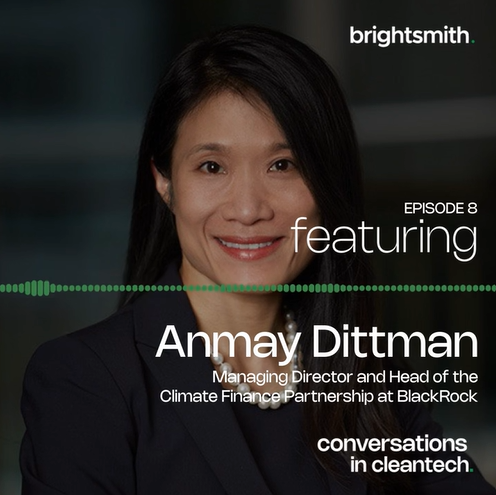
Anmay Ditman, Managing Director and Head of the Climate Finance Partnership at Global Infrastructure Partners (GIP), part of BlackRock
At the helm of one of the fastest fundraises in BlackRock’s history, Anmay has mobilised over $700 million to accelerate renewable infrastructure in emerging markets - from Kenya’s landmark Lake Turkana wind farm to a growing pipeline of solar and storage investments across Africa and beyond. In this conversation, they explore what it really takes to deploy climate capital where it matters most: how blended finance can de-risk high-impact projects, why local engagement is the key to lasting success, and where the next frontier of opportunity lies - from energy access to data centres powering the digital future.

Ishan Jaithwa, VP Data Center and Utility – Cypress Creek Renewables (EQT Partners)
At the centre of one of the fastest capacity build-outs in the digital era, Ishan has helped redefine how data centres, utilities and investors collaborate to bring real power online at real scale and speed. From gigawatt-level urgency at AWS to building flexible, hybrid capacity solutions at Cypress Creek, this conversation explores what it truly takes to synchronise AI ambition with grid reality, how commercial innovation is outpacing technology, why partnership is now the core infrastructure, and where the next frontier lies as AI compresses decades of grid evolution into just a few years.
Upcoming Episodes
Releases 9 Dec 2025

Deep Dive: The Capabilities Behind Emerging Energy Systems
Written by Alan Sutherland, SVP Americas, this piece breaks down how Europe is creating demand-led momentum through binding SAF mandates while the US is scaling supply-led capacity through layered incentives.
As Alan explains, these two approaches are starting to converge, creating a new transatlantic flow of e-fuels shaped by regulation, feedstock eligibility, and cost competitiveness. As the SAF market shifts from regional policy to global trade dynamics, organisations will need leaders who can navigate both regulatory regimes, structure long-dated offtake agreements, and build teams around hydrogen, e-fuels, and compliance. Cross-market capability will become a defining differentiator for 2026.
Read the full piece on LinkedIn →
Written by Hetty Lowther, Senior Principal Consultant, and Jake Salem, Principal Consultant, based on their recent trip to Hamburg for the The Hydrogen & Carbon Capture Expo in October 2025, this article captures the sector’s shift from hype to delivery.
The article highlights a maturing market: projects moving toward FID, regional hydrogen hubs accelerating, and system integration becoming the central theme as hydrogen links into grids, storage, e-fuels, and industrial demand. As hydrogen transitions from standalone pilots to interconnected ecosystems, companies will require technical and commercial leaders who think in systems, not silos. Multi-disciplinary capability across engineering, operations, policy, and supply chain will be essential to build hubs, connect infrastructure, and ensure commercial viability. The 2026 workforce will need to be as integrated as the hydrogen value chain itself.
Current Opportunities in Europe & the US
Operations Director Oslo, Norway
Senior Finance Manager Amsterdam, Netherlands
Head of Business Development & Sales Germany (Remote)
Engineering Manager London, UK
Head of Sales Spain
Director of Development United States (Remote)
Head of Global Solar & Renewable Energy Strategy and Investment Frankfurt, Germany
Director of Policy San Francisco, USA
Construction Project Manager Milan, Italy
Interconnection Engineer Houston, USA
Holiday Cheers | Founders & Executives Happy Hour
Austin’s energy ecosystem is evolving at record pace. Clean power, mobility, fuels, storage, grid-edge and now AI-driven demand are all converging. We’re entering a world that simply needs more power, and no single technology will get us there. Real progress will come from collaboration across every corner of the transition.
With that in mind, we’re bringing together a select group of founders and senior executives for an evening designed to spark the cross-sector relationships that move our industry forward.
Holiday Cheers | Founders & Executives Happy Hour
Hosted By:
- Chloe England — SVP, Americas - Clean Power Generation
- Alan Sutherland – SVP, Americas - Low-Carbon Fuels & Tech
- Joseph Riley – Director - Future Mobility & Grid Edge

Let’s Talk Talent
Projects set the pace. People set the outcome.
As 2026 approaches, the organisations moving fastest are the ones treating talent as a critical-path item, not an afterthought. Brightsmith partners with industry, professional services & investment companies to secure the leaders who turn ambition into delivery, from engineering and operations to policy, commercial, and project execution.
If your next phase of growth depends on capability, clarity, and readiness, we help you build the teams that make it happen.

